 Minswap
Minswap linked MINt conversion to a timed liquidity staking program
Minswap's retired MINt program converted MINt into MIN at a 1:1 token ratio through liquidity provider (LP) staking. Participants staked MINt alongside eligible LP tokens for 45 days, after which MIN vested linearly over another 45 days. Conversion operated from April 16, 2022, to April 16, 2023; the program is no longer available.
The conversion schedule and the chosen LP lock governed different parts of the same position. Participants could harvest vested MIN while boosted farming rewards still required completion of the selected LP lock.
Staking MINt alongside eligible LP tokens enabled conversion
MINt supplied the tokens for conversion, while eligible LP tokens supplied the liquidity position that qualified for the program and earned farming rewards.
The token that converted into MIN
MINt was a Cardano native token distributed to early supporters. Its conversion right depended on participation in the retired program. Deposited MINt supplied the tokens that would become MIN after qualification. The LP stake supported that conversion and earned its own farming rewards.
The liquidity that supported conversion
LP tokens represented a share of a liquidity pool. Conversion required LP tokens from a pool with an available farm, paired with MINt in the dedicated staking arrangement. Someone whose eligible LP tokens already occupied an ordinary farm had to temporarily unstake them before entering conversion. The same underlying liquidity could therefore support a different reward arrangement, with different harvest conditions.
The LP requirement followed a MIN-based value ratio
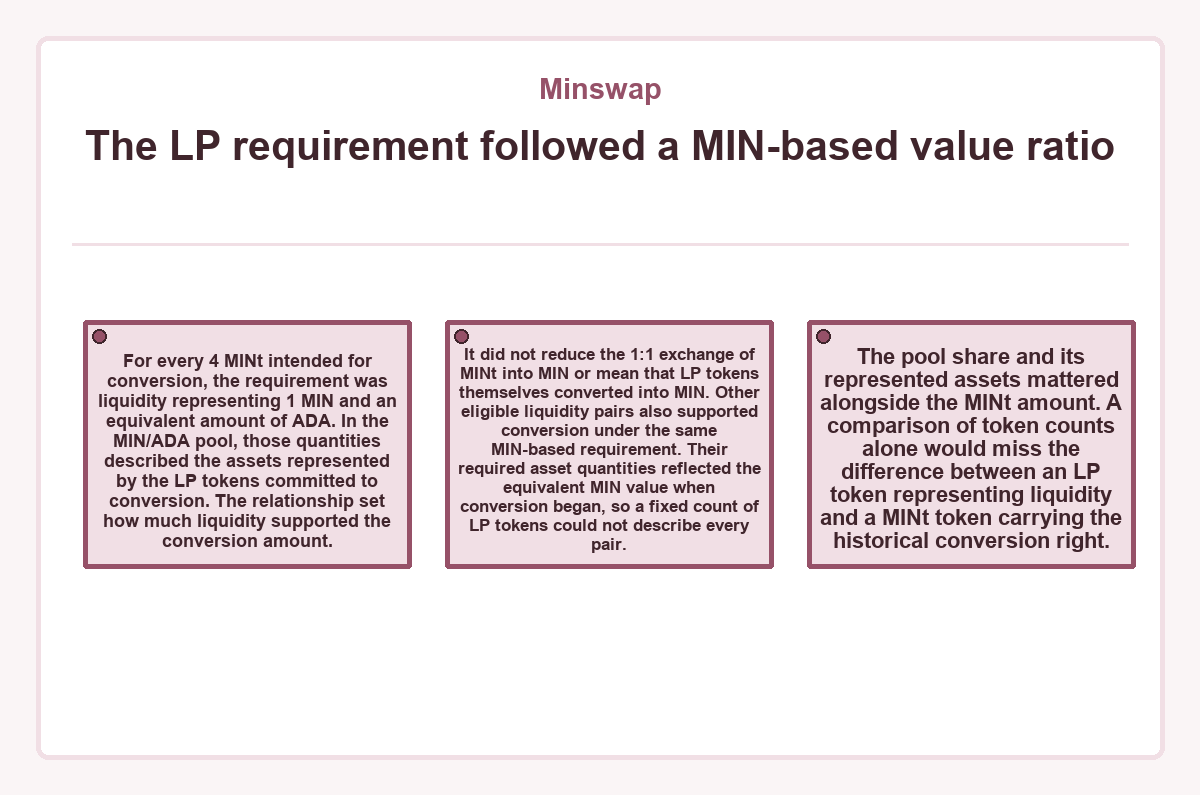
For every 4 MINt intended for conversion, the requirement was liquidity representing 1 MIN and an equivalent amount of ADA. In the MIN/ADA pool, those quantities described the assets represented by the LP tokens committed to conversion. The relationship set how much liquidity supported the conversion amount. It did not reduce the 1:1 exchange of MINt into MIN or mean that LP tokens themselves converted into MIN.
Other eligible liquidity pairs also supported conversion under the same MIN-based requirement. Their required asset quantities reflected the equivalent MIN value when conversion began, so a fixed count of LP tokens could not describe every pair. The pool share and its represented assets mattered alongside the MINt amount. A comparison of token counts alone would miss the difference between an LP token representing liquidity and a MINt token carrying the historical conversion right.
When did converted MIN become available?
Converted MIN became available gradually after an initial 45-day qualifying period, through a further 45 days of linear vesting. The longer LP lock choices did not extend that conversion schedule.
The initial 45 days
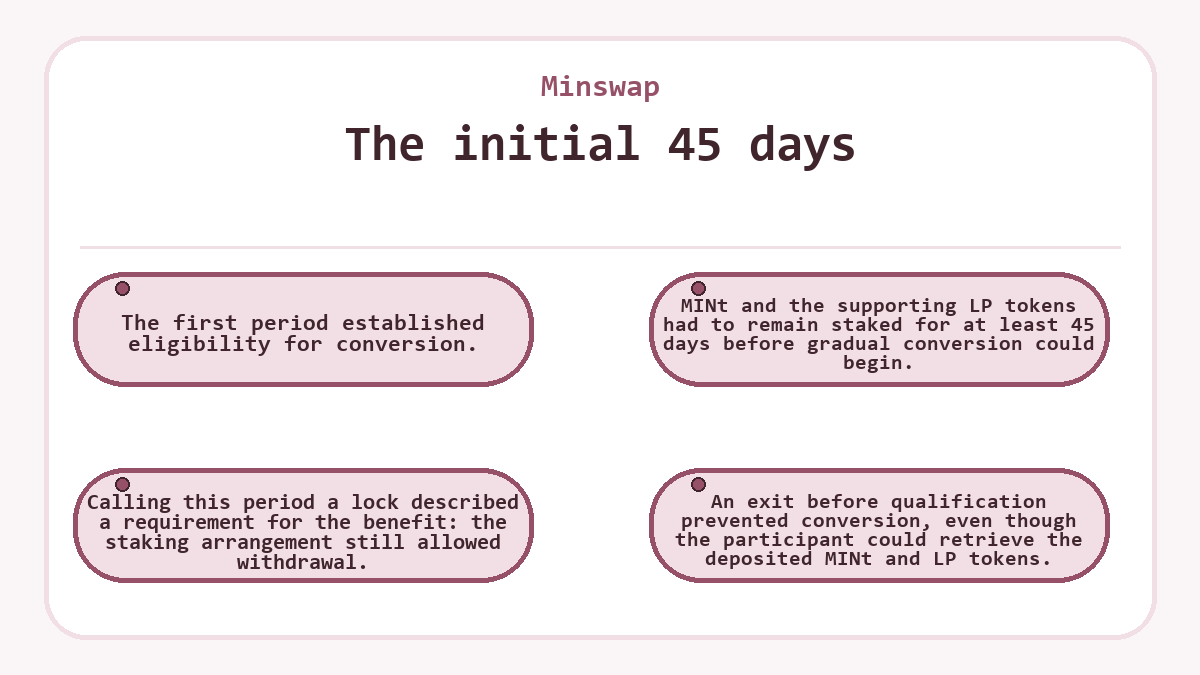
The first period established eligibility for conversion. MINt and the supporting LP tokens had to remain staked for at least 45 days before gradual conversion could begin. Calling this period a lock described a requirement for the benefit: the staking arrangement still allowed withdrawal. An exit before qualification prevented conversion, even though the participant could retrieve the deposited MINt and LP tokens.
The following 45 days
Linear vesting released the converted MIN progressively across the next 45 days. Participants could harvest the MIN that had already vested during that period. The complete conversion schedule therefore spanned 90 days from staking, provided the initial 45-day requirement was met. Receiving an early portion did not mean the entire conversion amount had become available; the remainder still followed its vesting schedule.
A 135-day LP commitment outlasted that conversion schedule. Its remaining duration concerned the farming boost attached to the LP tokens.
The selected LP lock determined farming rewards
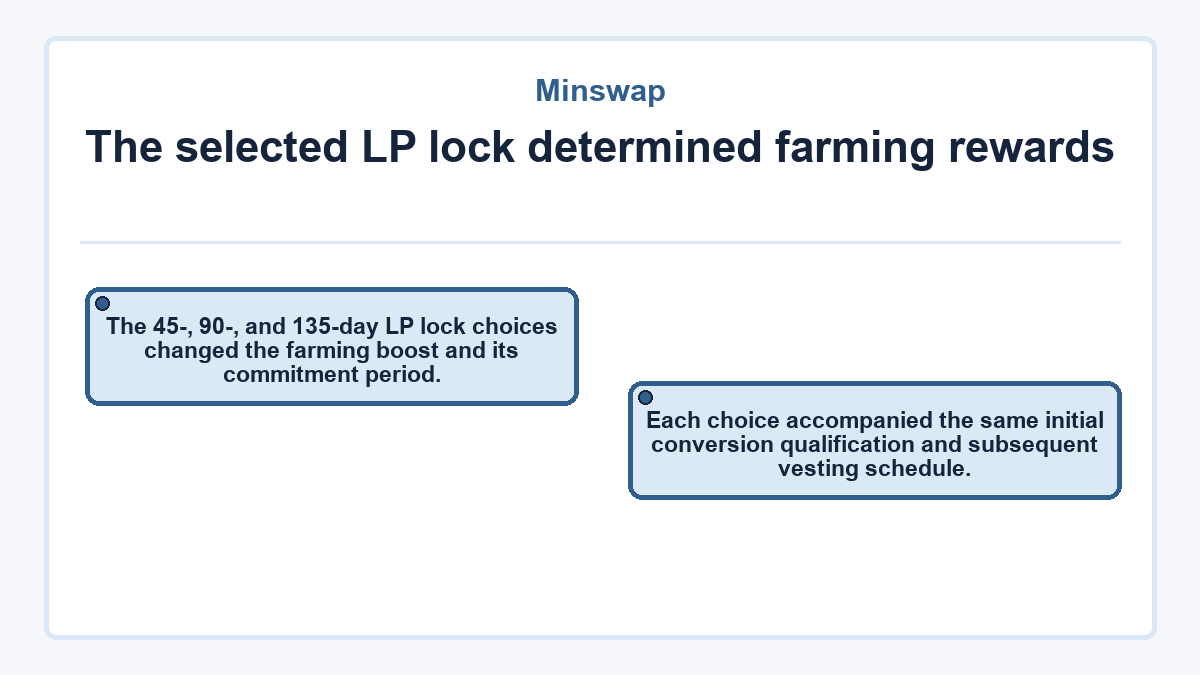
The 45-, 90-, and 135-day LP lock choices changed the farming boost and its commitment period. Each choice accompanied the same initial conversion qualification and subsequent vesting schedule.
Choosing the lock duration
The boost depended on both the eligible pool and the selected lock duration. Longer commitments offered larger multipliers on that pool's farming rewards. A multiplier described rewards relative to ordinary farming in the same pool, rather than a fixed investment return. It did not set the market value of MIN, and the liquidity position remained exposed to the assets represented by its LP tokens.
Harvesting farming rewards
While the LP tokens remained in the boosted position, accumulated farming MIN stayed unavailable for harvesting until the selected lock ended. Participants received those boosted rewards with their LP tokens when they unstaked after completing the commitment. Converted MIN followed its own release rules, so an available conversion amount did not make the farming balance harvestable. Both amounts used the MIN ticker, although different conditions governed when participants could collect them.
What did early withdrawal change?
An exit before 45 days prevented conversion, while leaving before the chosen LP lock ended forfeited the farming boost.
The arrangement allowed participants to retrieve their staked LP tokens and MINt during the initial qualifying period. That flexibility made leaving possible without completing conversion. Early exits returned ordinary farming rewards without the boost. On the longer LP lock choices, an exit after the initial 45 days could leave conversion proceeding through vesting while forfeiting the farming multiplier.
Reading an old withdrawal against its chosen lock
Consider a historical position that used the 90-day LP lock during the active program. Its owner first obtained LP tokens from an eligible pool, then staked them with MINt. Before the initial 45 days had elapsed, the owner could withdraw the deposits and stop conversion from qualifying. After conversion qualified, withdrawing the LP tokens no longer stopped that conversion.
Between day 45 and day 90, converted MIN vested while the farming boost still required continued LP staking. An LP exit during that interval returned the liquidity position with ordinary farming MIN, while conversion continued. Returned LP tokens therefore did not establish that the complete converted MIN amount had already reached the wallet.
- Check the original stake date to place the withdrawal before or after the 45-day qualifying boundary.
- Read the selected LP lock to determine whether the withdrawal preserved the farming boost.
- Compare the MIN received from conversion with the converted amount that had vested by the withdrawal date.
- Separate a recorded reward amount from tokens that a completed harvest delivered to the wallet.
A wallet record showing delivered MIN supported treating that amount as received. An amount still vesting required more time during the active program; an exit before qualification ended that conversion attempt. The holder could harvest any vested MIN that had not yet been collected.
The deadline ended the MINt conversion route
The MINt conversion window closed on April 16, 2023. The program had opened on April 16, 2022, and allowed conversion within that limited period. Its expiry removed the conversion function from a remaining MINt holding. Historical instructions about staking MINt described that program's operating window; they do not provide an available conversion route today.
MIN staking and ordinary yield farming have their own requirements. Their availability does not restore the retired MINt mechanism. A remaining MINt balance and MIN already received through conversion therefore present different decisions: the former no longer carries that program's conversion right.
What to know about Minswap
Where did the MINt tokens used for conversion originate?
MINt came from the FISO, or Fair Initial Stake Offering, and incentivized testnet airdrops. The planned distribution allocated 100,000,000 MINt to FISO participants and 5,000,000 to each of two testnet airdrops. FISO rewards comprised 80% MINt and 20% MIN, so receiving the original reward included tokens with different conversion requirements.
Which historical MIN/ADA lock offered a 2.5x farming boost?
The announced 2.5x boost applied to the MIN/ADA position with a 135-day LP lock. That pool's announced multipliers were 1.75x for 45 days and 2.1x for 90 days. These multiplied ordinary farming rewards for the same pool and period; they were historical program terms, not current rates or investment returns.
Did depositing extra liquidity boost every LP token?
Only the LP portion covered by the deposited MINt qualified for the historical boost. Extra LP tokens could remain in the wallet or earn ordinary rewards if staked in a normal farm. Adding liquidity did not increase the MIN released from a fixed conversion amount.
Could LP tokens keep earning after the selected boost period?
LP tokens left staked after the boost ended earned normal MIN farming rewards. That later farming did not renew the temporary multiplier or change the fixed amount of MIN released through conversion.
Was the 1:1 conversion ratio a guarantee of equal market prices?
The 1:1 ratio described token quantities released through conversion, not equal market prices. MINt and MIN had separate market prices during the program. Waiting for conversion also involved the liquidity commitment and vesting schedule, while the value of the eventual MIN depended on its market price. A price difference alone did not establish a realized profit.