 Minswap
 brings Cardano token swaps and liquidity provision together
Minswap is a Cardano decentralized exchange where users swap native tokens through liquidity pools. Providers add assets to those pools and receive liquidity provider (LP) tokens representing their share. Eligible farms offer incentives for staking LP tokens, while MIN staking uses the protocol token itself. Governance and Launch Bowl connect token participation with decisions and project liquidity. Each activity creates a different exposure: a swap changes token holdings, and a liquidity position remains exposed to both pooled assets.
Pool reserves, LP tokens, and MIN have distinct roles
Pool reserves supply the assets that traders receive, and an automated market maker calculates exchanges against those reserves. LP tokens record a provider's proportional pool ownership, including its share of trading-fee earnings. MIN gives holders a role in protocol governance and has its own staking arrangements. These objects answer different questions: which assets support a trade, who owns the liquidity, and who participates in protocol decisions. A MIN holding alone does not represent ownership of a particular pool.
What determines a swap's final output?
A swap's output depends on the selected route, available reserves, applicable fees, and the execution conditions that its order sets.
Pool pricing and slippage
Minswap V2 uses a constant-product formula for its ordinary pools, tying exchange prices to the quantities of tokens in reserve. Trade size relative to those reserves determines price impact. Larger relative trades receive less favorable rates. Stable pools use a different curve for assets intended to remain close in price. Their operation requires correct token parameters, and their pricing assumptions depend on that relationship between the assets.
Price impact measures the movement that the trade itself causes. Slippage describes a difference between the expected exchange price and the actual execution price. A minimum-output condition limits how little an order may receive when it executes. Raising slippage tolerance widens that acceptable range; it does not deepen the pool or improve its quoted price.
Routing, costs, and order execution
The aggregator searches liquidity across supported Cardano DEX protocols and can consider routes through multiple pools. Available liquidity and routing settings determine the paths that it evaluates. Minswap fees can include pool, protocol, and aggregation charges, depending on the route, alongside Cardano transaction costs. ADA attached to native-token outputs serves a different purpose: it satisfies the network's minimum-value requirements for those outputs.
Batchers collect Minswap pool orders and combine their execution in on-chain transactions. Submission and execution therefore describe different states. A wallet signature authorizes a transaction; it does not establish that an exchange has finished. Limit orders add a specified price condition to execution, giving the order a different purpose from accepting an immediately available swap quote.
Providing liquidity changes exposure to the paired assets
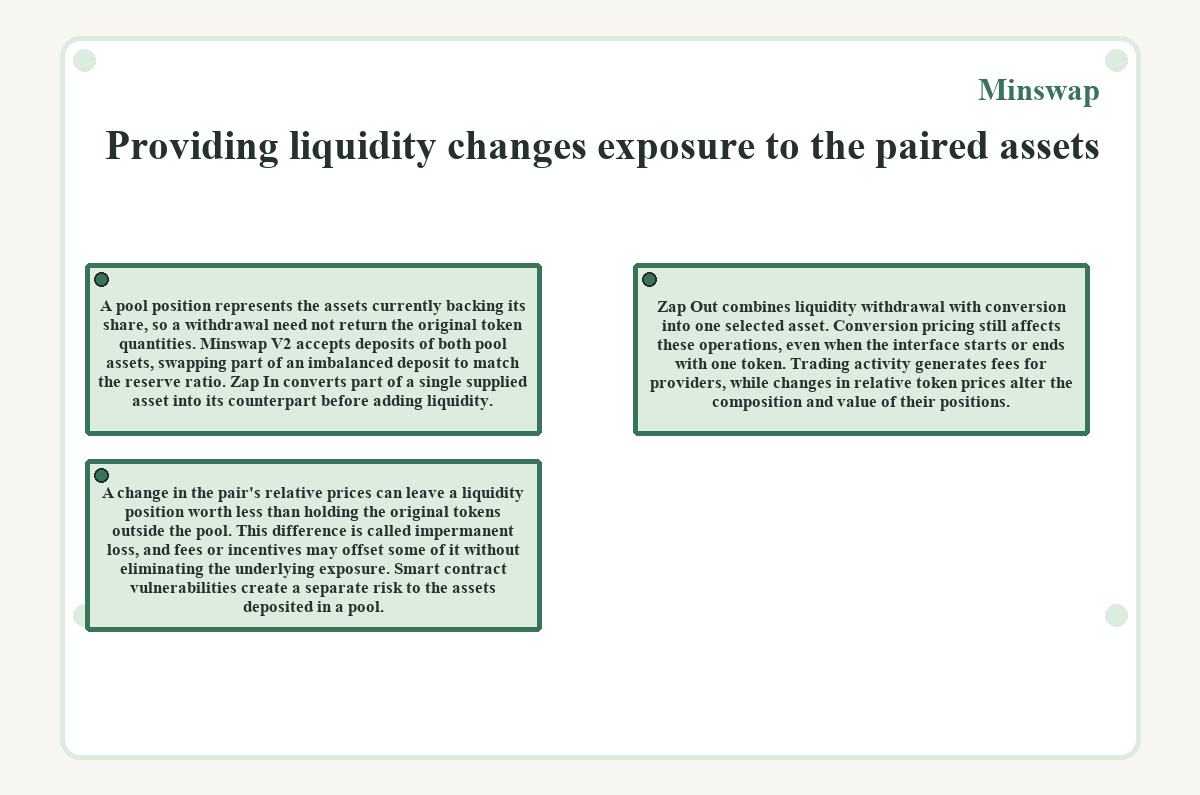
A pool position represents the assets currently backing its share, so a withdrawal need not return the original token quantities. Minswap V2 accepts deposits of both pool assets, swapping part of an imbalanced deposit to match the reserve ratio. Zap In converts part of a single supplied asset into its counterpart before adding liquidity. Zap Out combines liquidity withdrawal with conversion into one selected asset. Conversion pricing still affects these operations, even when the interface starts or ends with one token.
Trading activity generates fees for providers, while changes in relative token prices alter the composition and value of their positions. A change in the pair's relative prices can leave a liquidity position worth less than holding the original tokens outside the pool. This difference is called impermanent loss, and fees or incentives may offset some of it without eliminating the underlying exposure. Smart contract vulnerabilities create a separate risk to the assets deposited in a pool.
Does every liquidity position earn farming rewards?
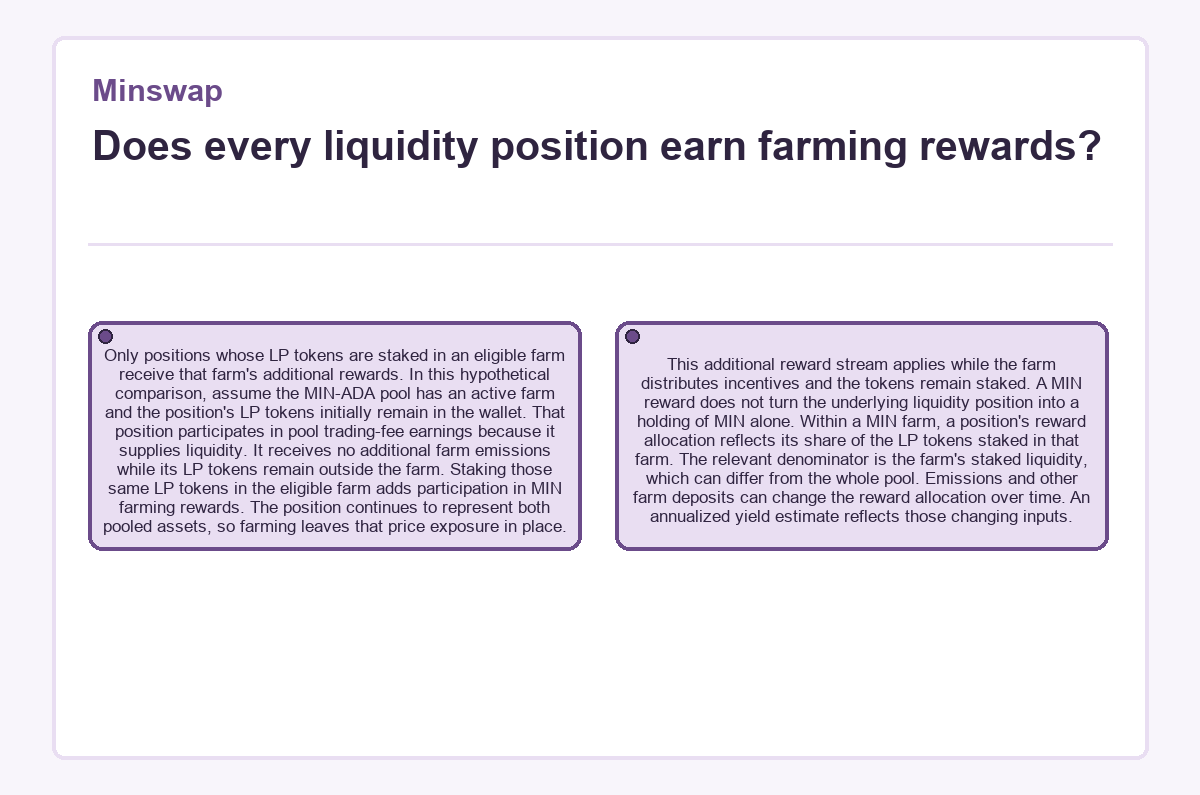
Only positions whose LP tokens are staked in an eligible farm receive that farm's additional rewards.
In this hypothetical comparison, assume the MIN-ADA pool has an active farm and the position's LP tokens initially remain in the wallet. That position participates in pool trading-fee earnings because it supplies liquidity. It receives no additional farm emissions while its LP tokens remain outside the farm.
Staking those same LP tokens in the eligible farm adds participation in MIN farming rewards. The position continues to represent both pooled assets, so farming leaves that price exposure in place. This additional reward stream applies while the farm distributes incentives and the tokens remain staked. A MIN reward does not turn the underlying liquidity position into a holding of MIN alone.
Within a MIN farm, a position's reward allocation reflects its share of the LP tokens staked in that farm. The relevant denominator is the farm's staked liquidity, which can differ from the whole pool. Emissions and other farm deposits can change the reward allocation over time. An annualized yield estimate reflects those changing inputs.
MIN staking and governance affect different parts of participation
Staking the protocol token
MIN staking uses the protocol token itself, and the Fee Switch directs a portion of trading fees toward ADA rewards for stakers. The Liquid Contract allows flexible redemption without early-exit penalties. The Tiered Contract uses a nine-month commitment, and early redemption reduces accrued rewards according to its penalty rules.
Voting with MIN or LP tokens
MIN holders participate in protocol governance, including decisions about incentives and treasury policy. Individual pool fee management has a separate governance mechanism. LP token holders can approve delegating fee adjustments to a manager, and the system supports revoking or transferring that authority. Protocol participation and ownership of a particular pool therefore carry different decision rights. The pool's trading-fee rate can consequently change under its approved management arrangements.
Launch Bowl connects token launches with project liquidity
Seeding an ordinary token pool
Launch Bowl includes ordinary pool listing and event-based liquidity programs for project tokens. Permissionless listing lets a project create a token pool, including a pair against ADA. The quantities initially supplied determine the starting exchange ratio. Token verification follows a separate process, so a listing does not establish the financial strength of the project behind its asset.
Liquidity bootstrapping events
LBE as a Service targets established projects launching tokens that have not yet entered circulation. Participants contribute ADA during the event window. Those contributions pair with project tokens to establish an initial pool, and participants receive LP tokens. Each event's contribution window and distribution terms govern participation. The Meteor LBE formed part of the mainnet launch in the first quarter of 2022. The MINt-to-MIN conversion program ended on April 16, 2023. Its former conversion and farming-boost terms no longer provide an available participation route.
Collective Zap-in and protocol-owned liquidity
Collective Zap-in targets established projects with an existing trading pool, pairing contributed ADA with project tokens over the event. Participants receive LP tokens at the end in proportion to their ADA contributions. Project-held LP tokens create protocol-owned liquidity: the project retains ownership of a portion of its market's reserves. Those holdings remain exposed to the paired assets, just as other liquidity positions do.
Market data and mobile access extend the pool view
Pool analytics distinguish deposited liquidity from trading activity, helping explain what a market's figures actually measure. Total value locked measures the value deposited, while volume records trading over a stated period. Fee data describes income from that activity. A large pool can have limited trading, and a busy market can have changing liquidity. Trading volume helps explain fee generation, while liquidity helps interpret the price impact of a potential swap.
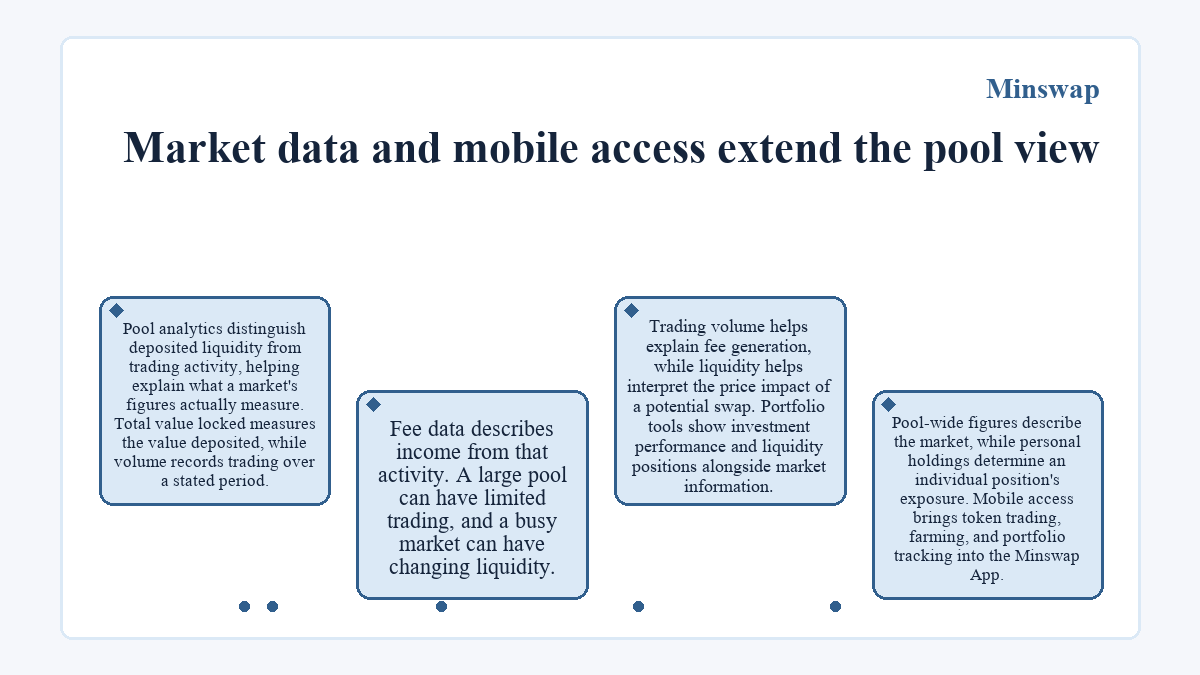
Portfolio tools show investment performance and liquidity positions alongside market information. Pool-wide figures describe the market, while personal holdings determine an individual position's exposure. Mobile access brings token trading, farming, and portfolio tracking into the Minswap App.
Minswap - your questions answered
Do I need MIN to swap Cardano tokens?
Ordinary swaps do not require a MIN holding. The transaction needs the input asset and enough ADA for applicable batcher fees, Cardano transaction costs, and any required native-token output deposits. MIN has separate uses in governance and staking. A trade involving MIN naturally needs it when MIN is the input asset, but that does not make it a requirement for other pairs.
Who can create a stable pool on Minswap?
The Minswap team reviews and configures stable pools because token decimals and pool parameters must fit the assets involved. Ordinary permissionless token listing does not automatically extend to stable pool creation. Incorrect parameters can disrupt the pool's pricing logic and put deposited assets at risk, so these pools require additional configuration checks.
Does a limit order guarantee that a trade will complete?
A limit order executes only when its specified price condition and the pool's execution requirements can be met. Submitting the order does not establish that those conditions will arise. It can remain unfilled when the available price does not satisfy the limit; the price condition controls acceptable execution rather than guaranteeing a completion time.
Can the portfolio view track multiple wallets?
The portfolio tools support adding multiple wallets to track investment performance. A combined portfolio and a single wallet's balances therefore describe different scopes, which matters when comparing their performance figures.
Where do token logos and decimal information come from?
Minswap obtains token metadata, including logos and decimals, from the Cardano Token Registry and CIP-68 metadata. This information helps the interface display assets and scale quantities correctly. Metadata handling and token verification are separate functions, so a recognizable logo or correctly formatted amount does not establish that a token has completed the verification process.